
When I was very new to electronics and had no experience or direction, one book helped point me on a path to building some very cool projects. “Robot Building for Beginners” by David Cook. In this book Cook describes all the basic components and design considerations necessary to build a simple hardware controlled robot. The nice thing about this book is that it recommends where to buy parts, what sorts of tools to have on hand as well as offers advice on how to make handmade robots functional and attractive. Before I had taken electronics as an undergraduate or done a single co-op, I already had an understanding of transistors, LED and basic motor drive circuits, fly-back diodes, filter capacitors as well as soldering, breadboard assembly and many more skills that I’m sure will serve me well for years to come. The result was my first handmade robot, Lionel (the Line Follower).
Lionel was large, big slow and not too pretty but he was my first, and I’ve never disassembled him because of it. The wonderful thing about hardware controlled robots is that by their very construction they can’t help but do what they are designed to do. There is no question of buggy programming or faulty software, there is just a couple transistors and comparators and that’s it, an elegant (if limited) brain. As I moved on to microcontrollers and other electronics projects I I didn’t spend much time considering simple line followers until I had a desire to go back to the Robot Building for Beginners and see what I could do with my improved skill and experience. The result: “Little Guy”. A much smaller, faster, smarter and mechanically sound line following design.
Whereas Lionel used a bank of 4 photo-resistors to “see” the line, “Little Guy” uses two shielded photo-diodes, giving him a faster and more accurate response. Also, I was able to add a binary proximity sensor to the analog brains of “Little Guy”, in order to give him the added skill of stopping if an obstacle blocks his path. The circuit used in Little Guy can be seen below.
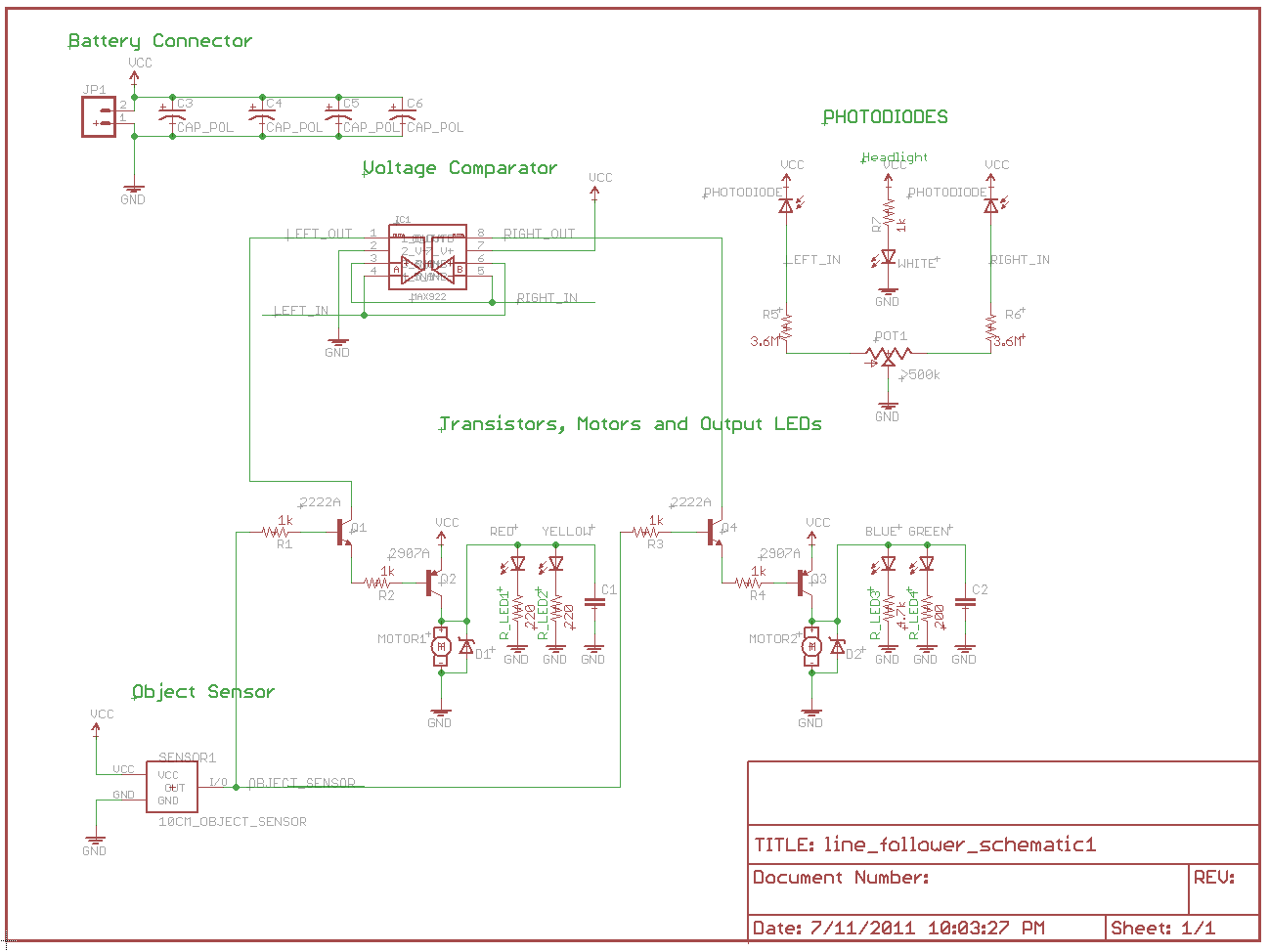
"Little Guy" Schematic
Obviously this schematic appears to be pretty simple, which it is, however the component layout was not as simple as you may think. Ordinarily the use of circuit layout software like CadSoft EAGLE allows for the rapid layout and placement of components, but this assumes the use of printed circuit boards (PCB) which are sometime difficult to come by in my apartment (although I do design custom PCBs for some of my projects). I planned to use a high quality double sided, plated perf-board for both the electrical system and as the structural body of “Little Guy”. I also wanted to make him as small as possible while still using through-hole components, so I attempted to build my own PCB component library for EAGLE based around the perf-board spacing.
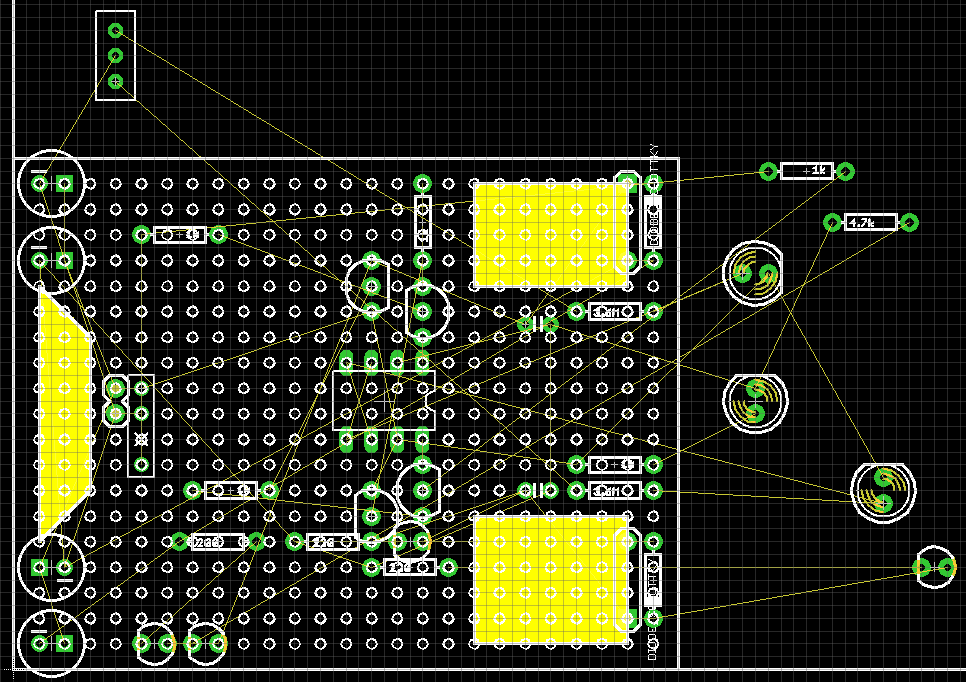
CadSoft EAGLE Used to Layout Perf-board
It turned out that in some ways the layout was easier to complete by hand on the actual board than on the computer, mostly because unlike a PCB where traces can be routed on the computer, with the Perf-board, I had to wire all the connections by hand with solid core hookup wire. Needless to say the PCB component library experience improved my PCB skills and reminded me how thankful I should be that mostly layouts are done with surface mount devices (SMDs) on a PCB.
Here’s a bit more of Lionel and “Little Guy” enjoying the same line.
 Spicer Robot Boy